Separate Bills With QR Code Ordering: How Splitting the Bill Works
How do separate bills work when guests order by phone? It depends on whether the QR code belongs to the table or to the guest. Here are the two models, what each means at the end of the evening, and how BiteTwo gives every guest their own bill.
 BiteTwo TeamNovember 15, 20266 min read
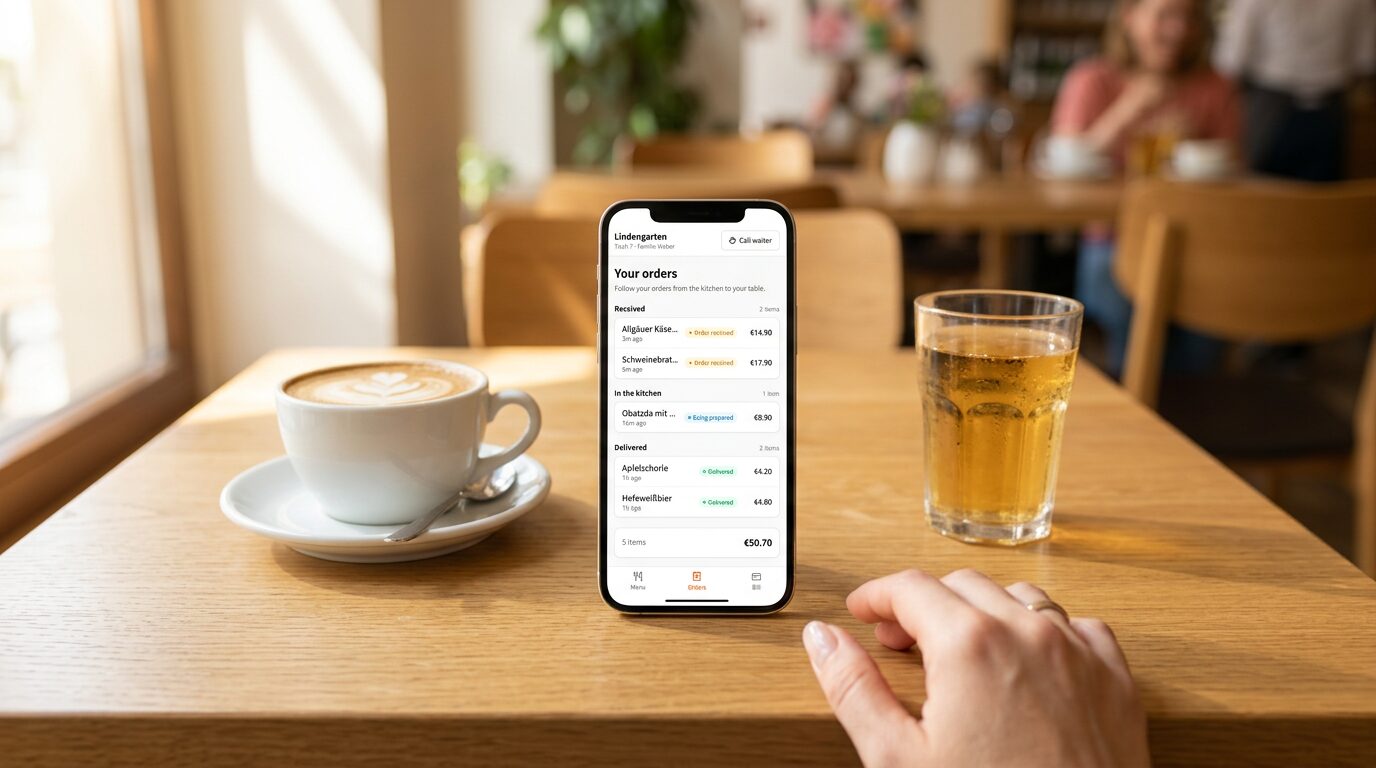
"Together or separate?" is the question that ends most restaurant visits, and with a table of eight it can take ten minutes: who had the second beer, who shared the starter, who pays for the birthday child. Owners who look at QR code ordering want to know whether it makes this easier or worse.
The short answer
It depends on what the QR code stands for. If one code belongs to the table, all orders land on one table bill, and it has to be split afterwards by the waiter or with a split function. If every guest has their own code, each order already belongs to one person and separate bills exist from the first drink. BiteTwo uses the second model: every guest gets a personal code and their own bill, and a guest who wants to pay for someone else takes over that person's unpaid orders after accepting a request.
How do the two models compare?
| One QR code per table | One code per guest | |
|---|---|---|
| Who does an order belong to? | The table | The guest who placed it |
| Separate bills | Split afterwards, item by item or in equal parts | Already separate |
| One person pays for all | The default | Guests hand their orders to the payer |
| Who had what? | Has to be remembered or asked | Shown per guest |
| Work at the start | None, the code is on the table | Staff create a code for each guest |
Neither model is wrong. A table code is the least work when a family eats together and one person pays. A personal code saves the discussion when colleagues, friends or a club sit together and everyone pays for themselves. In many restaurants the second case is the one that costs the team time.
How do separate bills work in BiteTwo?
When guests sit down, a staff member adds each guest to the table with one tap and shows a QR code and an 8-character code. Each guest scans their own code. From then on:
- Every order belongs to one guest. The team sees in the live list which guest and which table an order came from.
- Every guest sees their own bill on their phone: the items they ordered, the total and the VAT per rate.
- Paying is one request. The guest taps "Request the bill", the waiter comes to the table, and the guest pays their own total in cash or with the restaurant's card reader.
Nobody has to work out who had what, because the answer was recorded with every order.
Staff can also take orders for a guest in the same system. A guest without a phone still has their own orders and their own bill; the waiter simply enters the orders for them.
 At a table of friends, each guest orders with their own code, so each has their own bill at the end.
What if one person wants to pay for someone else?
Separate bills are the starting point, not a rule. For the cases where one guest pays for another, BiteTwo has a hand-over:
- The guest who is being invited opens their bill and taps "Let someone at your table pay".
- They pick the person who pays from the guests at the same table.
- That person sees a request on their own phone, with the number of orders and the amount, and taps Accept or Decline.
- After accepting, the orders are on the payer's bill.
Two rules keep this fair. The receiver has to accept, so nobody can push their drinks onto someone else's bill. And only unpaid orders can be handed over, within the same table or group.
This covers the common cases: a couple at a table of friends, parents paying for their children, the host paying for the whole round. For the last one, every guest hands over their orders and the host accepts each request.
What does BiteTwo not do?
- No splitting of a single item. A shared bottle of wine or a pizza for two is on the bill of the guest who ordered it. The hand-over moves all unpaid orders of a guest, not half of one dish.
- No payment in the app. BiteTwo shows each guest what they owe. The money is taken by your staff, in cash or with your own card reader.
- No fiscal receipt. BiteTwo is not a cash register. The official receipt comes from your till, as it does today.
For shared items, the simple routine is that one guest orders them and the others settle among themselves, or that guest takes over the others' orders and pays for all.
Does every guest really need their own code?
No. The code decides whose bill an order lands on, so you choose per table. If a couple or a family will pay together anyway, the waiter creates one guest for them and they order from one phone. If six colleagues come for lunch, six codes take a few more seconds at the start and save the discussion at the end.
Frequently asked questions
Can each guest get a separate bill with QR code ordering?
Yes, if the system ties orders to guests and not only to tables. In BiteTwo every guest has a personal code, and every order made with it is on that guest's own bill.
Can one guest pay for the whole table?
Yes. The other guests hand their unpaid orders to that guest, who accepts each request on their phone. Afterwards all orders are on one bill.
Can a guest move their orders to my bill without asking me?
No. A hand-over is only a request. The orders move only after the receiving guest has tapped Accept, and a declined request changes nothing.
Can we split one dish or one bottle between several people?
Not in BiteTwo. An item belongs to the guest who ordered it. Guests settle shared items among themselves, or one guest takes over the orders and pays.
Do guests pay their separate bill in the app?
No. Guests request the bill in the app and pay the waiter in cash or by card. BiteTwo does not process payments and takes no cut.
What about guests who do not use their phone?
The waiter takes their orders and enters them for that guest in the same system. The guest still has their own bill.
Conclusion
Separate bills are hard when a system only knows tables. They are easy when every order belongs to a person from the start. With a personal code per guest, the question "together or separate?" has an answer before anyone asks it, and guests who want to treat each other can do so with one request and one tap.
Start for free or book a demo to see how separate bills work at the table.