Risk-Free QR Ordering for Small Restaurants: Why BiteTwo Makes It Possible
A small restaurant cannot afford a failed software project. BiteTwo costs nothing, has no contract and works alongside your current routine, so you can introduce it gradually, on any evening, with nothing to lose.
 BiteTwo TeamOctober 31, 20266 min read
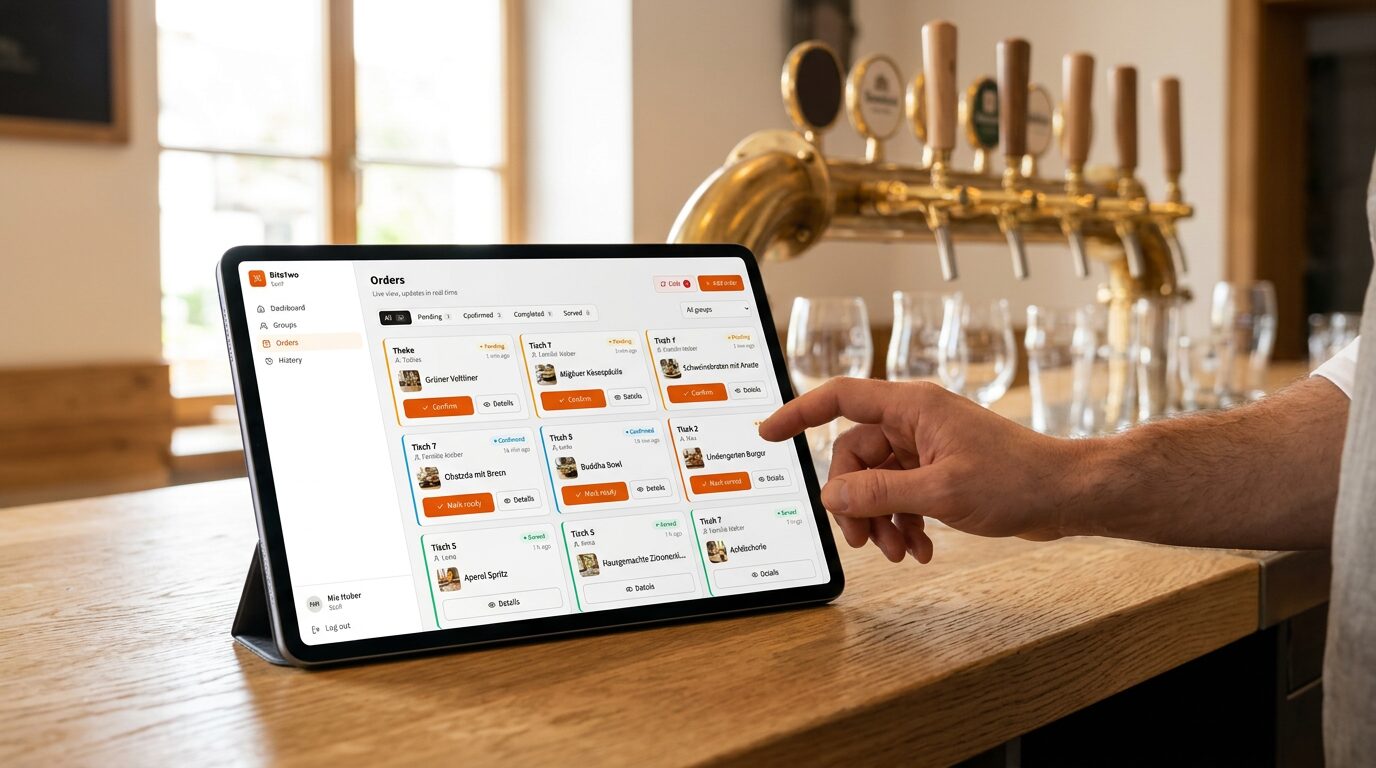
In a small restaurant, the owner is often also the cook, the host and the person who fixes the printer. There is no IT department and no budget for a project that might not work out. So when a new ordering system promises less running around and shorter waits, the sensible reaction is a question: what if it doesn't work for us?
That question is exactly why many small restaurants never try one. With most systems, finding out is expensive: a contract, a setup fee, new hardware, a few weeks of onboarding. You have to decide before you know.
This article is about the alternative. BiteTwo is built so that you can try it without deciding anything first: no fee, no commission, no contract and no hardware, and your team can keep taking orders the way it always has. Risk-free adoption is not a trial offer added on top of the product. It follows from how BiteTwo works, and it is what makes it a good fit for small restaurants.
Why small restaurants can gain the most
A small team feels every minute. A few things add up quickly in a restaurant with five tables or fifty seats:
- Waiting time at the table. Guests who want a second drink or the bill often have to catch someone's eye. When the waiter is at another table, that is a minute lost for both sides.
- The same trip twice. Walking to the table to take an order, then walking back because one more thing was forgotten.
- Busy evenings. The rush is when mistakes happen and when the team has the least time to take orders.
- Thin margins. A fixed monthly fee or a commission on every order is a lot to carry for a business with a handful of employees.
A system where guests can order and call the waiter from their own phone takes some of that load off, but only if it fits your restaurant. The risk is in finding out.
What makes a trial risky, and what does not have to
Most of the risk in a new system is not the technology. It is the commitment around it:
| What makes a trial risky | With BiteTwo |
|---|---|
| A monthly fee or setup fee you pay whether it works or not | No monthly fee, no setup fee |
| A commission on every order, which grows when you succeed | No commission, every order keeps its full margin |
| A contract with a minimum term | No contract, stop any time |
| New tablets, printers or terminals | No hardware, your team uses the phones and tablets you already have |
| A demo, a quote and weeks of onboarding | Register yourself, about 10 minutes until the first order |
| Guests who are forced to change their habits | Staff can enter every order themselves, nobody has to scan |
If nothing has to be paid, signed or bought, trying it costs you an hour at most. And the decision about whether to keep it is made with real evenings behind it instead of a sales presentation.
Start small: a path in three steps
Because staff can take every order in the same system, you decide how much changes. Here is one way to go, from least to most change. You can stop after any step.
Step 1: Only your team, one shift
Set up the menu and let your waiters enter the orders they take, on a phone or tablet they already carry. Guests notice nothing. You find out whether the live list of orders, the table overview and the waiter calls make service easier for you, without any guest involved at all.
Step 2: One table, one area, one evening
Pick the terrace, the bar or a few tables. The waiter opens a session for the guest with one tap and shows the QR code. Guests who like to order by phone scan it; for everyone else, the waiter keeps taking orders as usual. Nobody is forced, and regulars who prefer a conversation keep getting one.
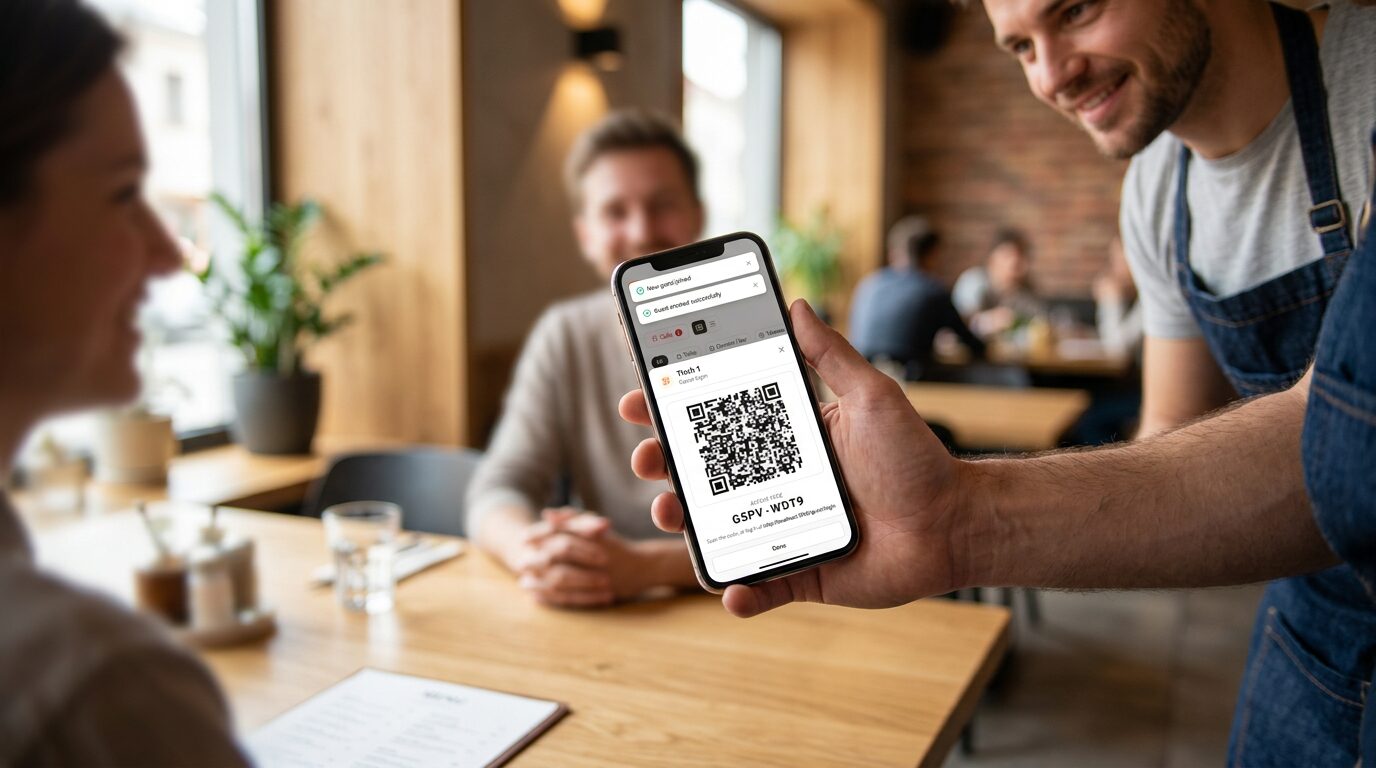 The waiter can start a visit, take the first orders and then show the guest their code: the guest takes over on their own phone, or doesn't.
Step 3: All tables
If steps one and two went well, offer it everywhere. You are not switching systems at this point: you are letting more guests do what a few already did.
Your existing routine stays your fallback
Trying something new is less frightening when going back is easy. With BiteTwo, it is:
- Your cash register stays. BiteTwo is not a cash register and does not issue fiscal receipts. It works next to the register you already have, so nothing in your accounting or your tax setup has to change.
- Paper still works. If a phone dies or the Wi-Fi drops, the waiter writes the order down like before. Nothing about your old way of working goes away.
- Your orders are not locked in. The History page shows past visits, and you can export the orders of any period as a CSV file for your own records.
The test phase can run any time
There is no right moment to start, because starting costs nothing and ends without notice:
- On a quiet Tuesday, to try it without pressure and learn how it feels.
- In the middle of the season, when the rush shows quickly whether it helps.
- For a single event, such as a birthday party, a club night or a wedding, where one evening is a complete test.
- Next week, next month or next year. There is no trial period that runs out. You are not on a clock.
And if it is not for you, you stop. No cancellation period, no notice, no leftover equipment.
What a trial can tell you
After an evening or two, you can answer questions that no brochure can:
- Do my guests actually use it, and which ones?
- Is the team faster, or just differently busy?
- Do the orders arrive the way the kitchen needs them?
- Is the menu easy enough for guests to read on a phone?
If the answers are good, you have a system that has already proven itself in your own restaurant. If they are not, you have lost a little time and no money.
What BiteTwo does not do
So that nothing surprises you in a trial, here is what BiteTwo deliberately does not cover:
- No cash register: no fiscal receipts (TSE), so keep your register.
- No kitchen printer: orders appear on the team's screens, not on paper.
- No payment processing: guests pay the waiter in cash or with your own card reader; there is no card terminal integration.
If one of these is essential for you, you know before you invest anything.
Conclusion
For a small restaurant, the best reason to try BiteTwo is not a feature. It is that trying costs nothing: no investment, no contract and no commitment, and that is exactly what a business with little time and little room for mistakes needs. You can start with your own team on one shift, add a table or an evening when you feel like it, and go back whenever you want. The test phase is open any time, and the decision stays yours.
Start for free or book a demo if you would like to see it first.